 By Thezoqo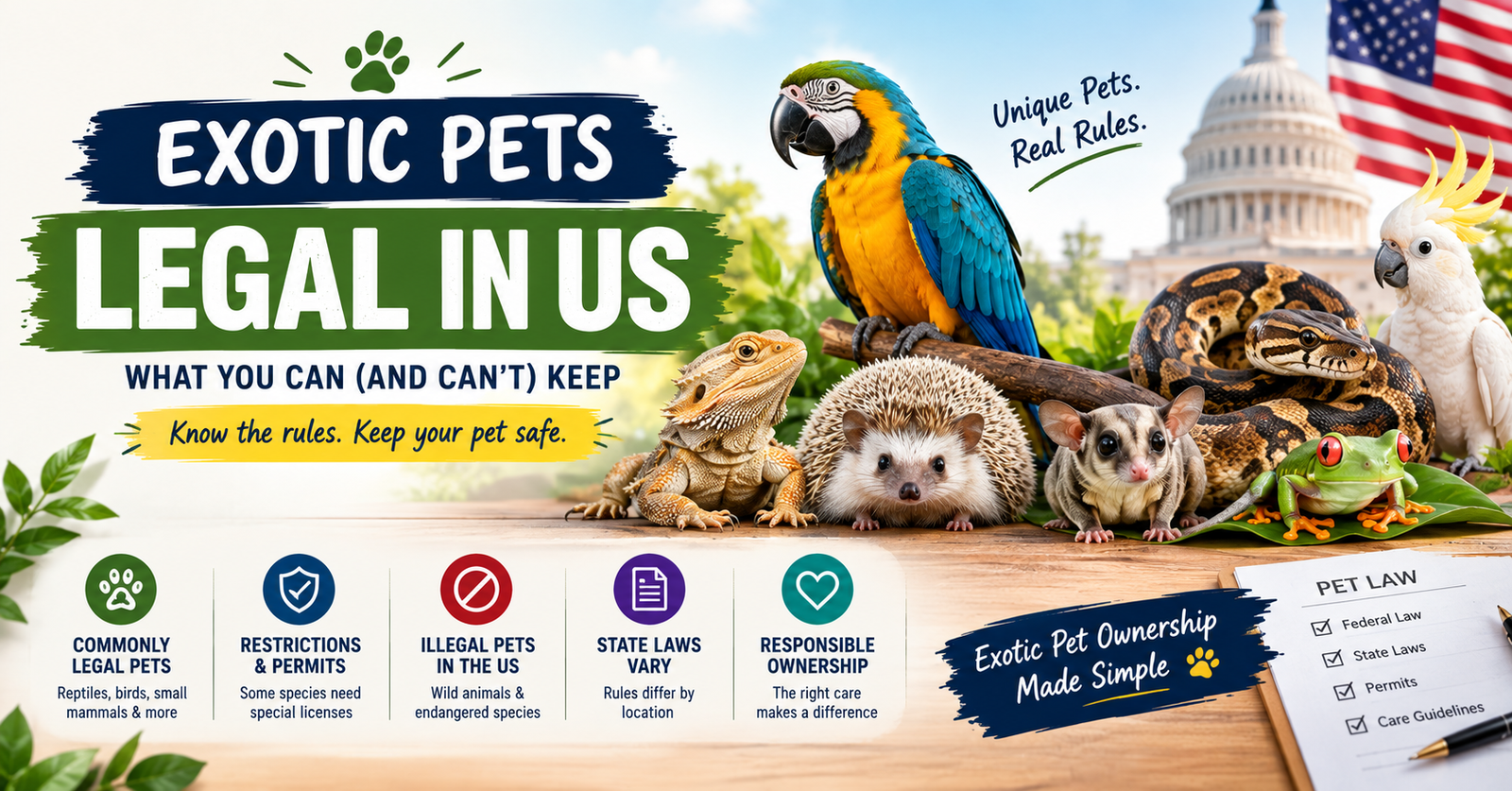
The world of companion animals extends far beyond traditional cats and dogs. Millions of households are fascinated by non-traditional choices, searching for exotic pets legal in US jurisdictions. The desire to share a living space with an extraordinary animal—such as a colorful reptile, a tiny marsupial, or a unique mammal—has grown significantly over the past decade.
Navigating the landscape of exotic pets legal in US regions requires a clear understanding of federal, state, and local requirements. Bringing a non-domesticated animal into your home involves legal compliance, specialized care, spatial arrangements, and proper veterinary attention.
This comprehensive guide breaks down federal regulations, state-by-state frameworks, legal species, necessary permits, and ethical responsibilities involved in keeping exotic pets legally across the United States.
Defining Exotic Pets Under United States Law
Before exploring specific legalities, it is essential to understand what constitutes an exotic pet under United States regulatory frameworks. Generally, an exotic pet is any animal that is not historically domesticated by humans. While dogs, cats, horses, and livestock are classified as domestic, almost all other non-native or wild species fall under the exotic umbrella.
The legal status of exotic pets legal in US states depends heavily on classification. A species considered a common companion in one region might be strictly regulated or entirely banned in another.
For example, ferrets are widely owned across North America, yet they remain banned as household pets in California and Hawaii due to ecological concerns regarding invasive species potential.
Classifications generally break down into four primary categories:
- Small Exotics: Sugar gliders, hedgehogs, chinchillas, and fennec foxes.
- Reptiles and Amphibians: Axolotls, non-venomous snakes, bearded dragons, and tegus.
- Exotic Birds: Macaws, toucans, and peafowl.
- Large Mammals and Wild Predators: Servals, wolves, big cats, and non-human primates.
Understanding these definitions helps prospective owners navigate local statutes without risking fines or confiscation.
The Regulatory Framework: How Exotic Pet Laws Work
Understanding which exotic pets are legal in US neighborhoods requires evaluating three distinct layers of government oversight: federal regulations, state laws, and local municipal ordinances.
1. Federal Regulations
At the national level, several primary statutes govern the trade, transport, and possession of wild animals:
- The Lacey Act: Prohibits the trade and interstate transport of illegally captured or designated harmful wildlife.
- The Endangered Species Act (ESA): Makes it illegal to buy, sell, or keep protected endangered species without specific scientific or conservation permits.
- The Big Cat Public Safety Act: Restricts private ownership of big cats such as lions, tigers, leopards, and jaguars, phasing out private possession across the country.
- The Animal Welfare Act (AWA): Administered by the USDA, setting minimum housing and care standards for commercial breeders and exhibitors.
2. State Legislation
While federal laws establish baseline prohibitions, individual states exercise primary authority over private ownership. State laws generally fall into one of four categories:
- Comprehensive Bans: States like California, Hawaii, New York, and Colorado strictly prohibit keeping most wild or exotic species as personal pets.
- Partial Bans: States prohibit specific dangerous animals—like bears, venomous snakes, or large primates—while permitting smaller species.
- Licensure Schemes: States allow ownership of various exotic animals provided the owner secures permits, passes site inspections, or holds liability insurance.
- Unrestricted/Minimal Regulation: States like Nevada, Alabama, and North Carolina have minimal statewide bans, placing most regulatory decisions onto local counties.
3. Municipal and Local Ordinances
Even if a specific species is fully legal under federal and state guidelines, city councils, county commissions, and Homeowner Associations (HOAs) frequently enforce local bans. A city may prohibit keeping non-domestic pets within residential zones regardless of state permits.
Exotic Pets Legal in US States: Popular Categories
Many exotic animals are legally kept across various parts of the country. Below is a detailed look at commonly owned species, their legal profiles, and basic care considerations.
Sugar Gliders
Sugar gliders are small, nocturnal marsupials native to Australia and Indonesia. Known for their ability to glide between tree branches using a thin membrane called a patagium, they are popular for their playful nature and bonding instincts.
- Legal Status: Legal in the majority of states. However, they are banned in California, Hawaii, Alaska, and Pennsylvania due to agricultural and native ecosystem concerns.
- Care Requirements: Sugar gliders are social colony animals that should never be kept alone. They require large vertical enclosures, a specialized diet consisting of nectar, insects, and fresh fruits, and regular social interaction.
Hedgehogs (African Pygmy Hedgehog)
African Pygmy Hedgehogs are quiet, solitary mammals covered in smooth spines. They are favored by exotic pet enthusiasts seeking a low-noise, space-efficient companion.
- Legal Status: Restricted or prohibited in California, Hawaii, Georgia, Pennsylvania, and the five boroughs of New York City.
- Care Requirements: Hedgehogs require warm, temperature-controlled enclosures (72°F to 80°F) to prevent dangerous hibernation states. Their diet consists primarily of high-quality insectivore kibble supplemented with live mealworms or dubia roaches.
Fennec Foxes
The fennec fox is the smallest member of the canid family, easily recognized by its oversized ears that help dissipate desert heat. They are energetic, vocal, and visually striking.
- Legal Status: Legal with or without permits in states like Texas, Florida, Indiana, and Ohio, but strictly banned in states with broad wild-canid prohibitions.
- Care Requirements: Fennec foxes retain strong wild instincts. They require escape-proof outdoor enclosures, deep digging substrates, specialized taurine-rich diets, and extensive behavioral enrichment.
Axolotls
Axolotls are neotenic salamanders native to the Xochimilco lake complex near Mexico City. Unlike most amphibians, they reach adulthood without undergoing metamorphosis, keeping their aquatic larval features—including feathery external gills.
- Legal Status: Banned in California, Maine, New Jersey, and Virginia due to ecological risks associated with releasing non-native aquatic species into local waterways.
- Care Requirements: Axolotls require cool water temperatures (60°F to 68°F), gentle filtration, safe substrates like fine sand, and regular water quality testing to prevent ammonia toxicity.
Servals and Hybrid Cats
Servals are medium-sized wild cats native to sub-Saharan Africa. Savannah cats—a cross between a domestic cat and a serval—are often sought out as alternative exotic companions.
- Legal Status: Pure servals are restricted or prohibited in most states, requiring specialized wild animal permits. Savannah cats are regulated based on their generation (e.g., F1, F2, F3), with early generations subject to wild felid restrictions.
- Care Requirements: Servals need massive secure outdoor habitats, specialized whole-prey diets, and high enclosures to accommodate their extraordinary vertical jumping abilities.
State-by-State Overview: Where Exotic Pets Are Legal in the US
The law varies depending on your geographic location. Below is an overview of regional trends across the United States:
States with Strict Bans
States like California, Hawaii, New Jersey, New York, and Georgia maintain restrictive bans on non-domestic animals. In California, keeping ferrets, sugar gliders, hedgehogs, and wild felids without research or educational permits is illegal. Hawaii strictly limits animal imports to protect its delicate island ecosystems from invasive species.
States with Permit Systems
States like Florida, Texas, Indiana, Pennsylvania, and Ohio use structured licensing systems. Florida utilizes a class-based system:
- Class I: Dangerous wildlife (elephants, big cats, rhinos) – prohibited for personal possession.
- Class II: Servals, cougars, baboons – requires permits, documented experience, and site inspections.
- Class III: Smaller mammals, birds, and reptiles – often requires standard permits or no permit depending on the species.
States with Few Statewide Restrictions
States like Alabama, Nevada, and North Carolina lack broad statewide bans on many exotic animals. However, municipal governments within these states frequently enact their own strict local regulations. Prospective owners must check county ordinances before purchasing an exotic animal.
To research general species profiles and wildlife conservation classifications, visit Wikipedia for educational overviews. For detailed breakdowns of pet lifestyle trends, animal welfare guides, and practical care tips, explore The Zoqo for additional resources.
Essential Checklist Before Acquiring an Exotic Pet
Bringing a non-traditional animal into your home involves legal, financial, and logistical preparation. Complete the following steps before committing:
- Step 1: Verify Local Legality: Never rely solely on advice from breeders or pet stores. Contact your state’s Department of Natural Resources, Fish and Wildlife Commission, or local animal control office directly to confirm species legality in your specific zip code.
- Step 2: Secure Necessary Permits: If your state requires a permit, complete all application processes prior to taking custody of the animal. This may involve paying registration fees, submitting enclosure blueprints, passing a home inspection, or showing proof of liability insurance.
- Step 3: Locate an Exotic Veterinarian: Traditional small-animal veterinarians rarely treat non-domestic species. Before acquiring your pet, locate a licensed board-certified avian or exotic animal veterinarian within driving distance. Ensure they are taking new patients and offer emergency care.
- Step 4: Evaluate Financial Costs: Exotic pet ownership requires significant financial commitment. Costs extend far beyond the initial purchase price to include custom enclosures, UV lighting, specialized live diets, and ongoing exotic veterinary visits.
- Step 5: Plan for Lifespan and Behavioral Traits: Many exotic animals live far longer than common domestic pets. Macaws can live over 60 years, tortoises can exceed 80 years, and small mammals like capybaras require multi-decade commitments. Additionally, many exotics retain wild behaviors, such as territorial marking, nocturnal activity, or loud vocalizations.
Ethical and Conservation Considerations
Legal compliance is only one part of responsible ownership. Ethical stewardship requires considering the welfare of the individual animal and the broader ecological impact.
Captive-Bred vs. Wild-Caught
Always purchase animals from reputable, captive-bred sources or dedicated exotic rescues. Removing wild animals from their native habitats harms natural populations, risks introducing disease, and causes severe stress to the animal. Captive-bred animals are generally healthier, better adapted to human presence, and ethically sound.
Preventing Ecosystem Damage
Never release an exotic pet into the wild. Non-native species released into non-endemic ecosystems can become destructive invasive pests, disrupting native wildlife and habitats. The release of Burmese pythons into the Florida Everglades serves as a clear warning regarding the ecological impacts of non-native species release.
If you are no longer able to care for your exotic companion, contact dedicated wildlife sanctuaries, specialized rescues, or state surrender programs.
FAQs: Exotic Pets Legal in US
What is the easiest exotic pet to legally own in the US?
Animals like sugar gliders, bearded dragons, and chinchillas are widely legal across many states and have well-established care guides. However, local restrictions still apply depending on your location.
Can I travel across state lines with my legal exotic pet?
Traveling across state lines with an exotic animal requires careful research. An animal that is legal in your home state may be illegal in a state you pass through or move to. The federal Lacey Act prohibits transporting illegally possessed wildlife across state boundaries. Always verify transport laws and obtain interstate health certificates from your veterinarian prior to travel.
Are sloths legal to own in the United States?
Sloths are legal in select states (such as Florida, Nevada, and Texas) with appropriate permits or registration, but they are strictly prohibited in states with broad exotic mammal bans. Sloths require specialized habitats, continuous humidity control, and precise dietary management.
How do I apply for an exotic pet permit?
Permit processes vary by state. Typically, you must apply through your state’s wildlife management or agriculture department, complete a background check, pay licensing fees, and pass a facility inspection to prove your enclosure meets safety standards.
Final Thoughts
Determining which exotic pets are legal in US states requires thorough research into federal statutes, state laws, and local municipal codes. While keeping a non-traditional animal can be a uniquely rewarding experience, it demands significant commitment, financial investment, specialized care, and strict legal adherence.
Always prioritize the safety and welfare of the animal. Verify species legality through official wildlife agencies, build an escape-proof enclosure, secure access to specialized veterinary care, and source your pet ethically through captive breeders or dedicated rescues. By approaching exotic pet ownership responsibly, you can enjoy a unique animal companionship while protecting local ecosystems and wildlife resources.