 By Thezoqo
If you’re planning to upgrade your television this year, one big question probably comes to mind: 4K vs 8K TV Comparison — is it really worth upgrading now?
With technology evolving rapidly, TV brands are promoting 8K as the future of home entertainment. But does that mean your 4K TV is outdated? Or is 8K still too early to invest in?
In this detailed guide, we’ll break down everything you need to know about 4K vs 8K TV Comparison
What is 4K Resolution?
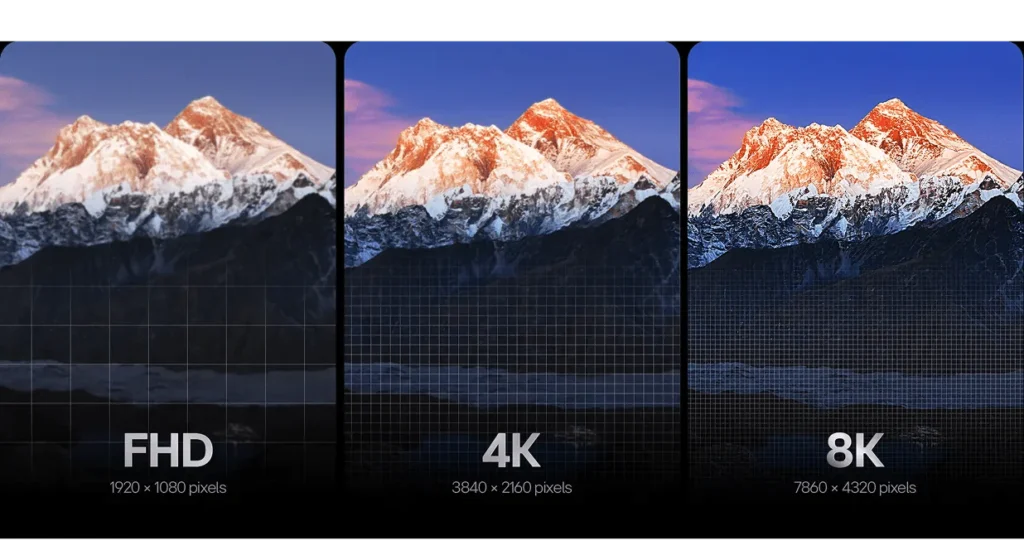
4K resolution refers to a display with approximately 3840 x 2160 pixels.
That equals:
- Over 8 million pixels on screen
- Four times more pixels than Full HD (1080p)
4K TVs are now the industry standard. Almost all mid-range and premium TVs come with 4K resolution.
Benefits of 4K TVs:
- Sharp and detailed images
- Widely available streaming content
- Affordable pricing
- Excellent gaming support
- Mature and optimized technology
In 2026, 4K TVs offer excellent value for money.
What is 8K Resolution?
8K resolution features 7680 x 4320 pixels.
That equals:
- Over 33 million pixels
- Four times more pixels than 4K
- Sixteen times more pixels than Full HD
On paper, 8K sounds revolutionary. But the real question in our 4K vs 8K TV Comparison is:
Can you actually see the difference?
4K vs 8K TV Comparison: Resolution Explained
Let’s compare the numbers clearly:
| Feature | 4K TV | 8K TV |
|---|---|---|
| Resolution | 3840 x 2160 | 7680 x 4320 |
| Total Pixels | ~8.3 million | ~33 million |
| Pixel Density | High | Extremely High |
| Ideal Screen Size | 43”–75” | 65”+ |
Technically, 8K offers more detail. But in real-life viewing conditions, differences depend on:
- Screen size
- Viewing distance
- Content quality
Can You Really See the Difference Between 4K and 8K?
Here’s the honest truth in this 4K vs 8K TV Comparison:
Most people cannot see a major difference between 4K and 8K on screens smaller than 65 inches.
To truly notice 8K resolution:
- You need a very large screen (75 inches or bigger)
- You need to sit relatively close
- You need true native 8K content
Otherwise, the difference is minimal.
4K vs 8K TV Comparison: Content Availability
This is the most important factor.
4K Content Availability (2026)
4K content is everywhere:
- Netflix
- Amazon Prime Video
- Disney+
- YouTube
- Gaming consoles (PS5, Xbox Series X)
- Blu-ray discs
4K is fully supported and mainstream.
8K Content Availability (2026)
Here’s the issue:
- Very limited native 8K content
- Minimal 8K streaming
- Rare 8K broadcasting
- Very few 8K games
Most 8K TVs rely on AI upscaling to convert 4K content into 8K resolution.
So in practical terms, you’re mostly watching upscaled 4K.
4K vs 8K TV Comparison: Picture Quality
Now let’s analyze picture quality beyond just resolution.
Sharpness
- 8K is technically sharper
- But only noticeable on very large screens
For 55″ or 65″ TVs, 4K already looks extremely sharp.
Contrast & Color
Resolution does not determine contrast or color accuracy.
Picture quality depends more on:
- Panel type (OLED, QLED, LED)
- HDR support
- Brightness levels
- Color calibration
A high-end 4K OLED will look better than a budget 8K LED TV.
4K vs 8K TV Comparison: Gaming Performance
Gamers should pay attention here.
4K Gaming
- Fully supported by PS5 & Xbox Series X
- Stable 60–120 FPS support
- Widely optimized
8K Gaming
- Very limited support
- Extremely demanding on hardware
- Few games run native 8K
Currently, 4K gaming is more practical and optimized.
4K vs 8K TV Comparison: Price Difference
Let’s talk money.
4K TVs
- Affordable
- Wide price range
- Budget to premium options available
8K TVs
- Significantly more expensive
- Premium category only
- Limited size options
You may pay almost double for 8K compared to similar 4K models.
4K vs 8K TV Comparison: Future Proofing
Many buyers think:
“Should I buy 8K to future-proof my investment?”
Here’s the reality:
- 4K became mainstream over 8–10 years
- 8K adoption is still very slow
- Broadcasting infrastructure is limited
- Internet speeds still restrict 8K streaming
By the time 8K becomes standard, newer technologies may already be available.
4K vs 8K TV Comparison: Screen Size Matters
The bigger the screen, the more 8K makes sense.
Under 55 inches
4K is more than enough.
65 inches
4K still excellent.
75 inches and above
8K may show slight improvements.
If you’re buying a massive home theater display, 8K can be more appealing.
4K vs 8K TV Comparison: Bandwidth & Storage
Streaming 8K requires:
- Very high internet speed
- Large bandwidth
- Advanced compression
Many households still struggle with stable 4K streaming speeds.
So 8K streaming may not be practical for everyone.
Who Should Buy a 4K TV in 2026?
You should choose 4K if:
- You want value for money
- You stream Netflix or YouTube
- You play PS5 or Xbox
- You watch sports and movies
- You’re buying under 75 inches
4K is practical, affordable, and future-ready.
Who Should Buy an 8K TV in 2026?
8K makes sense if:
- Budget is not a concern
- You want cutting-edge technology
- You’re buying 75” or larger
- You want the best possible pixel density
- You plan to keep the TV for many years
Even then, the difference may not justify the cost for most users.
Pros and Cons Summary
4K TV Pros
- Affordable
- Massive content support
- Great for gaming
- Excellent picture quality
4K TV Cons
- Not as pixel-dense as 8K
- May feel less “future-ready”
8K TV Pros
- Extremely sharp resolution
- Premium technology
- Better upscaling processors
8K TV Cons
- Expensive
- Very limited content
- Minimal visible difference for many users
Final Verdict: 4K vs 8K TV Comparison — Is It Worth Upgrading Now?
After analyzing everything in this detailed 4K vs 8K TV Comparison, here’s the honest answer:
For 90% of buyers in 2026, upgrading from 4K to 8K is NOT necessary.
4K TVs already offer:
- Incredible sharpness
- Wide content availability
- Better price-to-performance ratio
- Optimized gaming support
8K is impressive, but practical benefits are limited right now.
If you want smart spending, choose a high-end 4K TV instead of a basic 8K TV.
Buying Tips Before You Upgrade
Before making a final decision:
- Prioritize panel quality over resolution
- Check HDR support (Dolby Vision / HDR10+)
- Look for HDMI 2.1 ports
- Choose 120Hz refresh rate
- Consider room size and viewing distance
Resolution alone does not guarantee better picture quality.
Frequently Asked Questions (FAQs)
Is 8K four times better than 4K?
In terms of pixel count, yes. In real viewing experience, not necessarily.
Is 8K worth it for gaming?
Not yet. Very limited native 8K gaming support exists.
Will 8K replace 4K soon?
Not in the near future. 4K will remain dominant for years.
Is 4K outdated in 2026?
Absolutely not. It is still the industry standard.
Conclusion
When it comes to 4K vs 8K TV Comparison, the decision depends on your budget, screen size, and expectations.
For most people:
👉 4K is more than enough
👉 8K is premium but unnecessary
👉 Panel quality matters more than resolution
Unless you want cutting-edge luxury technology, stick with 4K and invest in better panel technology instead.
6tfk9a