 By Thezoqo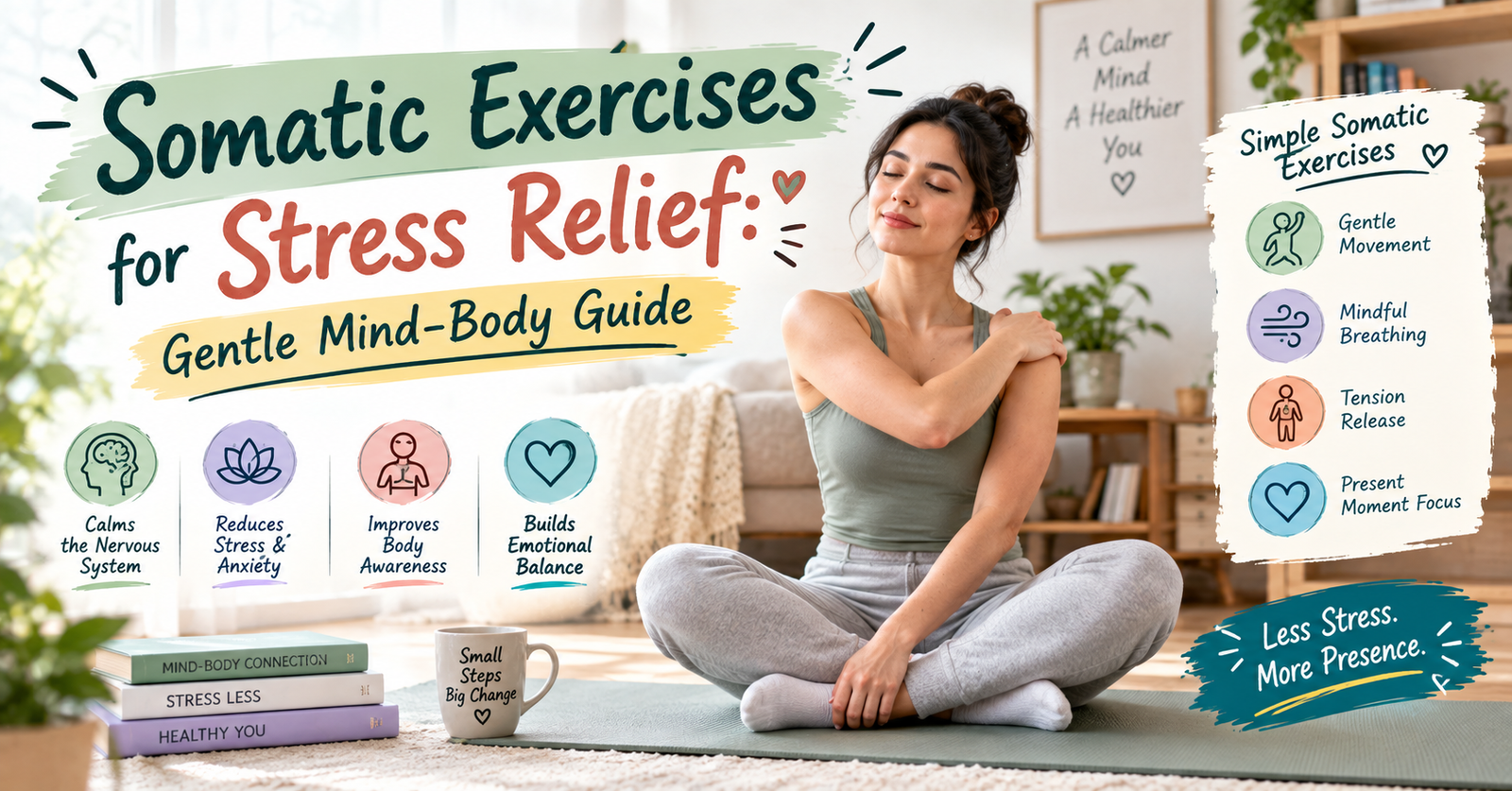
Modern life places constant demands on our nervous system. From endless work notifications and tight deadlines to personal responsibilities and societal pressures, chronic stress has become an everyday reality for millions. While traditional exercise routines focus on burning calories or building cardiovascular endurance, they often fail to address the deep-seated tension stored within our muscles and connective tissue. This is where somatic exercises for stress relief offer a transformative approach to physical and emotional healing.
Unlike high-intensity workouts that push the body to its physical limits, somatic movement focuses entirely on internal physical perception and sensation. By slowing down, listening to your body’s subtle signals, and re-educating the nervous system, you can gently discharge stored trauma, reduce chronic physical pain, and restore your body to a natural state of calm.
This comprehensive guide explores the science behind somatic movement, breaking down daily routines and practical techniques to help you harness somatic exercises for stress relief in your daily life.
What Are Somatic Exercises?
Somatic movement is a gentle, mind-body practice designed to bring conscious awareness to internal bodily sensations. The term stems from the Greek word soma, which translates to “the body living from within.”
Rather than executing movements for aesthetic goals or external performance, somatic practices train your brain to recognize where your body holds unconscious tension. Through small, deliberate, and mindful movements, you help your brain re-establish healthy communication channels with chronically tight muscle groups.
To understand the neurological basis of body awareness, you can learn more about sensory perception on Wikipedia, which outlines how the brain processes internal bodily signals and touch sensations.
Practicing somatic exercises for stress relief allows you to tap into this internal communication network, effectively releasing muscle tightness that conscious willpower alone cannot unwind.
The Physiology of Stored Stress and the Nervous System
To understand why somatic exercises for stress relief is so effective, it helps to look at how your nervous system responds to perceived threats.
When you experience stress—whether from a sudden fright or chronic daily pressure—your body activates its sympathetic nervous system. This triggers the classic “fight, flight, or freeze” response. Your heart rate accelerates, breathing shallowly moves to the upper chest, and muscles across the neck, shoulders, jaw, and hips contract to prepare the body to react.
The Trauma Trap and Sensory-Motor Amnesia
In a natural setting, once a threat passes, the body completes its stress cycle through shaking, sighing, or deep resting. However, modern chronic stress rarely has a clear endpoint. As a result, the nervous system remains stuck in a state of high alert.
Over time, chronically contracted muscles forget how to relax completely—a neurological condition known as Sensory-Motor Amnesia. The brain effectively loses the conscious ability to control these muscle groups, leaving them permanently locked in a tight state.
Integrating somatic exercises for stress relief retrains the motor cortex in your brain, teaching tight muscle fibers how to elongate and release voluntarily once again.
Essential Somatic Techniques for Stress Relief
There are several core somatic techniques that restore balance to the nervous system. Integrating these foundational practices into your routine helps soothe an overactive stress response. here are somatic exercises for stress relief:
1. Pandiculation: The Natural Stress Release
Pandiculation is the body’s natural method of resetting muscle tone. It is the deliberate, slow contraction of a muscle, followed by a slow, conscious lengthening, and ending in a complete release. Animals do this naturally every time they wake up from a nap by stretching outward and shaking.
Unlike passive stretching—which forcibly pulls on cold muscle tissue and can trigger a protective reflex—pandiculation works directly with the brain to restore optimal muscle length.
- How to do it: Consciously tighten a tense muscle group (like pulling your shoulders up toward your ears) to about 50 percent of maximum effort. Hold for three seconds, then take a full five seconds to slowly lower your shoulders downward, paying close attention to the sensation of the muscle fibers lengthening. Rest completely at the bottom.
2. Vagus Nerve Reset
The vagus nerve is the main component somatic exercises for stress relief of your parasympathetic nervous system, responsible for regulating heart rate, digestion, and the “rest and digest” response. Toning the vagus nerve signals to the brain that you are safe.
- How to do it: Sit comfortably with your spine tall. Interlock your fingers and place them behind your head. Keeping your head facing straight forward without turning your neck, shift only your eyes to look all the way to the right. Hold your gaze there until you naturally sigh, yawn, or swallow (usually between 30 to 60 seconds). Bring your eyes back to center, then repeat looking all the way to the left.
3. Somatic Body Scanning and Tracking
Tracking involves bringing non-judgmental curiosity to bodily sensations. Rather than labeling a feeling as “bad pain,” you observe its physical qualities—such as warmth, tightness, tingling, or heaviness.
- How to do it: Lie down on a comfortable mat. Close your eyes and direct your attention slowly from your toes up to the crown of your head. Notice where your body makes contact with the floor, where breath flows easily, and where tension feels held, without immediately trying to change anything.
For more insights into holistic health, wellness lifestyle tips, and modern self-care practices, explore resources hosted on https://thezoqo.com/.
Step-by-Step Somatic Exercises for Daily Stress Relief
Here is a targeted somatic movement sequence designed to release common areas where stress accumulates: the jaw, neck, chest, lower back, and hips.
Exercise 1: The Somatic Cat-Cow (Spinal Lengthening)
Traditional yoga cat-cow focuses on flexible spinal extension. The somatic version focuses entirely on micro-sensations along each vertebra.
- Starting Position: Begin on all fours with your hands under your shoulders and knees under your hips.
- The Movement: As you inhale, slowly tilt your pelvis to arch your back, letting your belly drop toward the floor while keeping your neck neutral. Focus on the sensation of your spinal muscles contracting softly.
- The Release: As you exhale, take double the time to slowly round your spine upward toward the ceiling, tucking your chin gently toward your chest. Pay close attention to how your back muscles slowly lengthen out.
- Repetitions: Perform 5 slow repetitions, focusing entirely on smooth, jerk-free movement.
Exercise 2: Pelvic Clock (Lower Back & Hip Unwinding)
The hips and pelvic region store immense amounts of emotional and physical tension, often leading to chronic lower back stiffness.
- Starting Position: Lie on your back with your knees bent and feet flat on the floor, spaced hip-width apart. Imagine a clock face resting flat on your lower abdomen, with 12 o’clock at your belly button and 6 o’clock at your pubic bone.
- The Movement: Gently tilt your pelvis so your belly button drops toward the floor (12 o’clock). Then, slowly tilt your pelvis in the opposite direction so your lower back arches slightly off the floor (6 o’clock).
- Circling the Clock: Slowly roll your pelvis around the perimeter of the clock face, touching 3 o’clock (right hip drops slightly) and 9 o’clock (left hip drops slightly).
- Repetitions: Complete 3 smooth clock rotations clockwise, then 3 counter-clockwise.
Exercise 3: Shoulder Blade Pandiculation (Upper Back Release)
Stress frequently manifests as tight, elevated shoulders and a tight upper chest.
- Starting Position: Sit comfortably in a chair or lie flat on your back.
- The Movement: Inhale deeply and slowly squeeze your shoulder blades back toward your spine, contracting the muscles between your shoulder blades.
- The Lengthening: As you exhale, slowly—over a count of six seconds—release the contraction, letting your shoulder blades drift apart and slide down your back.
- Repetitions: Repeat 4 times, noticing the deep wave of warmth in your upper back as the tension releases.
Exercise 4: Constructive Rest and Tremoring
Constructive rest allows the psoas muscle—the deep core hip flexor heavily involved in the fight-or-flight response—to release stored energy safely.
- Starting Position: Lie on your back with your knees bent, feet flat on the floor about mat-width apart. Let your knees knock together gently in the center so your legs support themselves without muscular effort.
- The Practice: Place one hand on your chest and one hand on your belly. Breathe softly into your abdomen. If your legs or core begin to micro-shake or tremor softly, allow it to happen. Tremoring is a natural neurological release mechanism used by the body to discharge excess adrenaline.
- Duration: Rest in this position for 10 to 15 minutes daily.
Psychological Benefits of Regular Somatic Movement
While physical ease is a direct result of practicing somatic exercises for stress relief, the psychological advantages are equally profound.
Enhanced Interoception and Emotional Regulation
Interoception is your ability to perceive internal bodily signals, such as your heartbeat, breathing rate, hunger, or muscle tension. Research shows that individuals with strong interoceptive awareness regulate their emotions far more effectively.
When you practice somatic tracking, you learn to notice stress signals in your body early—such as a clenched jaw or shallow breath—before they escalate into full-blown anxiety or panic.
Breaking the Chronic Pain-Stress Cycle
Stress creates physical muscle tension, and chronic physical muscle tension sends threat signals back to the brain, producing more stress. Somatic exercises break this vicious feedback loop. By relaxing physical muscle tissue, you communicate directly to your brain that the immediate threat has passed, allowing your mental state to calm down alongside your body.
How to Create a Daily Somatic Stress Relief Routine
Consistency is far more valuable than intensity when working with the nervous system. A short, 10-minute daily practice yields significantly better results than an hour-long session performed once a month.
Morning Routine: Setting the Nervous System Tone
Spend 5 minutes in bed before getting up. Perform a gentle pelvic clock and a few shoulder pandiculations to wake up your motor cortex and prepare your body for movement without rushing.
Mid-Day Reset: De-stressing at Your Desk
If you spend long hours sitting at a computer, perform a 2-minute vagus nerve reset or seated shoulder pandiculation every two hours. This prevents tension from accumulating in your neck and upper back throughout the workday.
Evening Wind-Down: Preparing for Deep Sleep
Dedicating 10 minutes before bed to constructive rest and somatic cat-cow exercises signals your parasympathetic nervous system that it is safe to sleep, leading to deeper, more restorative sleep cycles.
Best Practices for Maximizing Your Somatic Practice
To get the most out of somatic exercises for stress relief, keep these essential principles in mind:
- Move Slowly: Speed prevents sensory awareness. Cut your movement speed in half, then cut it in half again.
- Never Push Through Pain: Pain causes the nervous system to contract protectively. Always stay within a comfortable, pain-free range of motion.
- Focus on Internal Sensation: Keep your eyes closed or lower your gaze to eliminate visual distractions. Focus entirely on how the movement feels from the inside out.
- Breathe Naturally: Avoid holding your breath. Match your movements to smooth, unhurried abdominal breathing.
- Embrace Stillness: Pause for a few seconds between movements to allow your brain time to register the changes in muscle tone.
Summary of Key Takeaways
- Somatic Movement Defined: Gentle, internal-focused exercises that re-educate the nervous system and release stored physical tension.
- The Science: Retrains the brain to overcome Sensory-Motor Amnesia caused by chronic stress.
- Key Techniques: Pandiculation (contracting and slowly lengthening), vagus nerve resets, and non-judgmental body tracking.
- Core Exercises: Somatic Cat-Cow, Pelvic Clock, Shoulder Pandiculation, and Constructive Rest.
- Daily Integration: Short, consistent 5-to-10-minute daily practices produce the most profound, lasting reductions in stress.
Final Thoughts on Somatic Healing
Integrating somatic exercises for stress relief into your daily life offers a compassionate, effective pathway toward lasting physical and emotional calm. By shifting your focus from external performance to internal listening, you give your nervous system the exact tools it needs to let go of stored strain, restore mobility, and cultivate a deep, abiding sense of peace within your body.