 By Thezoqo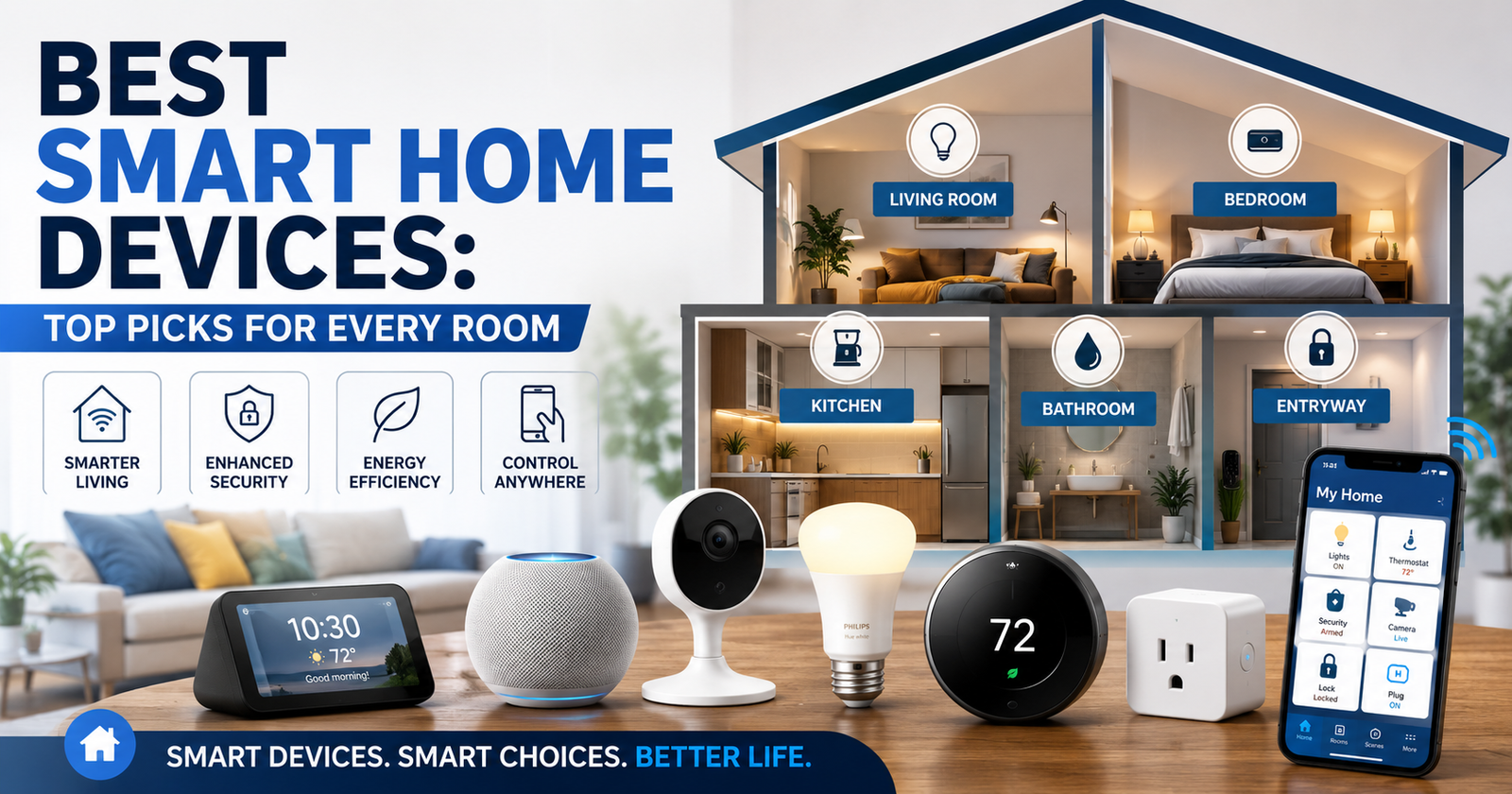
Building a connected home is no longer a futuristic luxury—it is to choose best smart home devices which shoud be accessible, everyday way to add convenience, improve security, and lower monthly energy bills. Whether you want to turn off forgotten lights from your smartphone, adjust the temperature automatically, or see who is at your front door, the right smart home technology simplifies daily routines.
However, with thousands of connected gadgets available, knowing where to start can feel overwhelming. To help you make informed decisions, this guide highlights the best smart home devices across essential categories, ensuring seamless compatibility and long-term value.
The Essential Smart Home Framework
Before purchasing individual gadgets, it helps to understand how a best smart home devices. Most connected setups rely on three primary layers:
The Three Pillars of a Connected best smart home devices
1. Central Ecosystem / Voice Assistant (Alexa, Google, Apple)
2. Smart Hub & Protocols (Matter, Thread, Wi-Fi, Zigbee)
3. Connected End-Devices (Lights, Plugs, Locks, Cameras)
Selecting devices that support common smart protocols (like Matter and Thread) ensures that products from different brands work together effortlessly within your preferred ecosystem.
best smart home devices by Category
1. Smart Speakers and Displays (The Control Hub)
Smart speakers serve as the primary voice-controlled command center for your entire setup.
- Amazon Echo Studio / Echo Show: Ideal for users heavily invested in the Amazon Alexa ecosystem, offering rich room-filling audio and intuitive smart home controls.
- Google Nest Hub Max: Excellent for users reliant on Google Calendar, YouTube, and Google Assistant, featuring a bright screen and gesture controls.
- Apple HomePod Mini: The top pick for Apple users prioritising high privacy standards, spatial audio, and seamless integration with Siri and HomeKit.
2. Smart Lighting & Smart Plugs (The Entry Point)
Smart lighting and plugs are the easiest, most cost-effective entry points for home automation.
- Philips Hue & Govee Smart LED Bulbs: Offer customizable color temperatures, scheduling, and app automation to transform home ambiance instantly.
- TP-Link Kasa / Tapo Smart Plugs: Allow you to turn traditional lamps, fans, and small appliances into app-controlled smart devices with scheduling and energy monitoring capabilities.
3. Smart Thermostats (Best for Energy Savings)
Heating and cooling account for a major portion of home energy costs. Smart thermostats optimize your climate control automatically.
- Google Nest Learning Thermostat: Features clean aesthetics and intelligent scheduling that adapts to your daily routines to minimize energy waste.
- ecobee Smart Thermostat Premium: Comes equipped with built-in occupancy and temperature sensors to ensure balanced heating and cooling across individual rooms.
4. Smart Security Cameras and Video Doorbells
Keep tabs on your property and receive instant notifications when motion or packages are detected.
- Ring Video Doorbell Pro & Blink Outdoor 4: Reliable, weather-resistant security solutions offering clear video feeds, motion zones, and wireless flexibility.
- Google Nest Doorbell & Arlo Security Cameras: Deliver crisp high-resolution feeds with advanced AI detection for people, animals, and vehicles.
Quick Comparison: Which Devices Offer the Highest ROI?
| Category | Primary Benefit | Ease of Setup | Energy/Cost Savings Potential |
| Smart Thermostats | Automated climate control | Moderate | High (Reduces heating/cooling bills) |
| Smart Plugs | Remote power control & schedules | Very Easy | Moderate (Cuts standby power waste) |
| Smart Lighting | Ambiance & automated schedules | Very Easy | Moderate (Efficient LED scheduling) |
| Smart Security | Real-time monitoring & peace of mind | Easy to Moderate | High (Prevents property loss) |
Frequently Asked Questions (FAQs)
Q1: What are the best smart home devices for beginners?
A: Smart plugs and smart lightbulbs paired with a basic smart speaker (like an Echo Dot or Nest Mini) are the best beginner options. They are inexpensive, simple to set up, and provide immediate daily utility.
Q2: Do all smart home devices work together?
A: Not automatically. Before buying, check if a product is compatible with your preferred assistant (Amazon Alexa, Google Home, or Apple HomeKit). Look for the Matter badge on product packaging, which guarantees cross-platform compatibility.
Q3: Can smart home devices actually help lower electricity bills?
A: Yes! Smart thermostats, smart radiator valves, and smart plugs with energy-monitoring features prevent unnecessary electricity and heating usage by turning devices off when rooms are unoccupied.
Conclusion
Upgrading your living space with the best smart home devices provides a seamless blend of convenience, security, and efficiency. By starting with a reliable smart speaker, adding energy-saving devices like smart thermostats and plugs, and choosing cross-compatible gear, you can build a responsive, intelligent home ecosystem tailored to your daily lifestyle.
As a bonus hunter navigating the layered player club of present-day betting platforms, your GPS should be thorough due diligence; kick off that expedition with BIZZO Australia where strategy-minded creators demystify all ranks, illustrating speed lanes to VIP yet keeping risk measured. Ahead of spinning your inaugural reel, compare credit multipliers: a handful of casinos grant a point for every dollar, while others require AU$5 or even AU$10 to earn matching benefit, transforming reward maximisation painfully sluggish. Equally vital is getting clear on redemption mechanics; might reward vouchers swap into spendable money, or should they route through spin wheels that slice equity? What’s more, hunt down weekly multipliers because stacking XP catapults rockets your rank journey, allowing you to reach sapphire status in record time. Nevertheless, fringe benefits aren’t gratis; wagering requirements tend to leash promos prior to thousands of dollars cycle through the platform, so scan the fine print with surgeon-level precision. When in doubt, lean on https://jordanmosermusic.art/ for a quick glossary that decode dense clauses. Next, embrace cashback deals soften cold streaks; even a modest cashback on aggregate downswing performs as emergency foam. But, avoid illusory refunds that lock value inside sticky bonus wallets; they dress up as gifts although fizzle once you request withdrawal, placing you back at square one. A secret-sauce tactic in the reward playbook is diversified deposit strategy, maintaining logins across two or three platforms; this diversification avoids cap collisions, as you tap fresh promotions on every platform pivot. Do remember every venue carries a current Australian licence, presents audited RTPs, and features withdrawal rails matching budget flexibility. Equipping yourself with budget trackers reveals creeping burn rate; a ready template maps out cash-to-comp exchange rates, illuminating if that shimmering elite status earns the rake. In conclusion, reward economics funnels toward a core principle: practical advantage should surpass money staked; stay curious, while secure steps to audited stats. Persist with the rules mapped, blend them with clear mind-states, and you’ll find the comp escalator tilting toward your pocket as opposed to emptying it. Protect that stance, and across sessions the Down Under betting world appear less intimidating and progressively become a grid of opportunity where caution yields fruit
As a digital nomad switching between client deadlines in Oz, https://paralay.world/ is my laboratory of luck whenever I crave a ten-minute recharge. Unlike the deafening clang of a land-based poker room or the blinding city strip, an interactive lounge allows me to shift from spreadsheet macros to spinning reels instantly. I view every hand dealt the exact manner I conduct an email split test: formulate a predictive model, fix a stop-loss, and refine before the variance snowballs. Because variance is simply another data series, testing slot dispersion becomes a low-stakes field for modeling the loss cadence that guides my crypto portfolio. Yet visual design counts too, and the low-glare palette preserves my executive bandwidth minimal so the prefrontal cortex keeps firing for evening sprint retros. That seamless union of design finesse and probability rigor is precisely why https://paralay.world/ sits pinned in my first tab whenever I plug into a shared studio from Byron Bay. With a single click I’m re-balancing Google Ads spend; then I’m charting session ROI in a plain CSV, color-coding confidence intervals the way some peers favorite cat memes. Colleagues assume an online casino is all fluff, yet I regard it like a decision lab: calculate risk of ruin, record the return percentage, run short trial sets, and ladder only when results converge. Whenever a reload promo hits, I decode the fine print the exact way I’d audit a SaaS contract, tagging advantageous terms and discarding unfavorable ones—because value doesn’t lie in the details. During slow evenings when storm clouds derail video shoots, I load a session of crash-style games and let the orchestration wash over noise-canceling cans, fueling a deep-work vibe that oddly resembles mindfulness breathing. My daily log confirms that a short casino interlude lowers subjective stress by over 30 percent, aligning with the cortisol slope reported in academic papers. Sure, the house edge persists, but just as index-fund fees buy server uptime, the modest margin pays for live chat support. Most importantly, I structure my bankroll the way I allocate business runway: the lion’s share is never-risk savings, 25 percent is R&D money, and the thin edge is moon-shot capital—positioned for upside or get vaporized without existential dread. This method locks my expectations realistic, reflecting the fractional staking I deploy in sports trading. Now and then a black-swan jackpot explodes, ballooning the stats the similar way a viral campaign skews my monthly KPIs, and I siphon that windfall toward noise-canceling upgrades—because return on ergonomics is huge. After sunset when Sydney’s skyline flicker, I close the casino tab with a json transaction dump, feed it to a Power BI view, and compare payout histograms against billable hours, seeking weak signals that might boost both creative throughput. Certain evenings the scatter plots align like a constellation, proving me that play and work share the same axis when you measure them with unbiased eyes. In the end, casino play work like contrast baths for the brain: controlled, monitored, data-driven, rebooting my risk gauge so I can hit publish at a higher cadence the next day. Regardless of whether I end the night flat as a pancake, the observations feed back into my continuous improvement loop, making the concept of gambling from mere entertainment into a quantified hobby where data rules emotion. Hence if you’re a fellow remote pro hunting down a structured way to puncture routine, test a few micro-stakes rounds, honor your limits, and realize how a insight-focused approach can evolve casino time into professional R&D—entirely while your espresso shot whirs quietly beside a Koala-shaded veranda.
As a spreadsheet-loving Aussie dissecting wagering offers, I treat every casino bonus less as glitter and primarily as a temporary advantage that calls for granular timing; prior to chasing that eye-catching match offer, hit the brakes and bookmark the 30-point checklist parked at PlayCroco promos. First up, set the endpoint: do you want lightning withdrawals on small wins or going for mega leverage because not every promo fits every mission. Next, a twist new players skip, inspect contribution grids: many pokie titles credit full turnover while table games shrink to 10 %. Third, timing matters: schedule a reminder ahead of burn so the rollover wraps well before the axe falls; rushing spikes variance. Fourth, don’t layer bonuses because stacking muddies audits. Fifth, maintain a stake diary with time stamps, title tags, stake value and wager remainder; an A4 notebook tops mental math. Sixth, note banking rails: many bonuses exclude e-wallets, and learning post-facto stings. Seventh, variance is neither enemy nor saviour: high variance may bust you but can finish turnover in a burst. Eighth, scale units: begin micro then step 1.25 ? only when the meter falls under 30 %. Ninth, map cash-out timing: peak support hours slow KYC; schedule verification uploads in mid-week. Tenth—and here we drop the plain reference exactly five sentences after the link—review ATO guidance on gambling income because untaxed windfalls might still flag audits; for source docs and calculator widgets see casino blended within the resource vault. Moving on, psychology cushions the edge: celebrate milestones not monolith wins, because over-excitement births careless over-bets. Activate micro-interval timers to reline focus. Next, hunt independent certs on payout percentages; grey operators mask audits. PlayCroco’s disclosure matrix lists rolling variance data, shrinking blind spots. Meanwhile, use crowd charts to spot bonus clawbacks; peer group signals parallels duplicate invoice checks. By now, we’re not “breaking” the house, yet shifting the expected value into manageable margin while locking promotional upside; picture each promo as a temporary arbitrage coupon that evaporates unless manufactured with meticulous method; casuals scatter offers like ticker-tape. Summing up, audit your entire exposure profile every four weeks: keep under 5 % cashflow, leave insurance premiums untouched, and interpret every cleared bonus as earned coupon income not as free lunch; such rigour lets you walk away smiling even when house edge claws back, while still enjoying the reels — since enjoyment, not insolvency, is the target
Bonus Bez Depozytu Nowe Kasyna beep beep casino login20€ no deposit bonuskasyno online na prawdziwe pieniadze
vavada uplata paysafecard kako https://www.vavada09537.help
батут цена